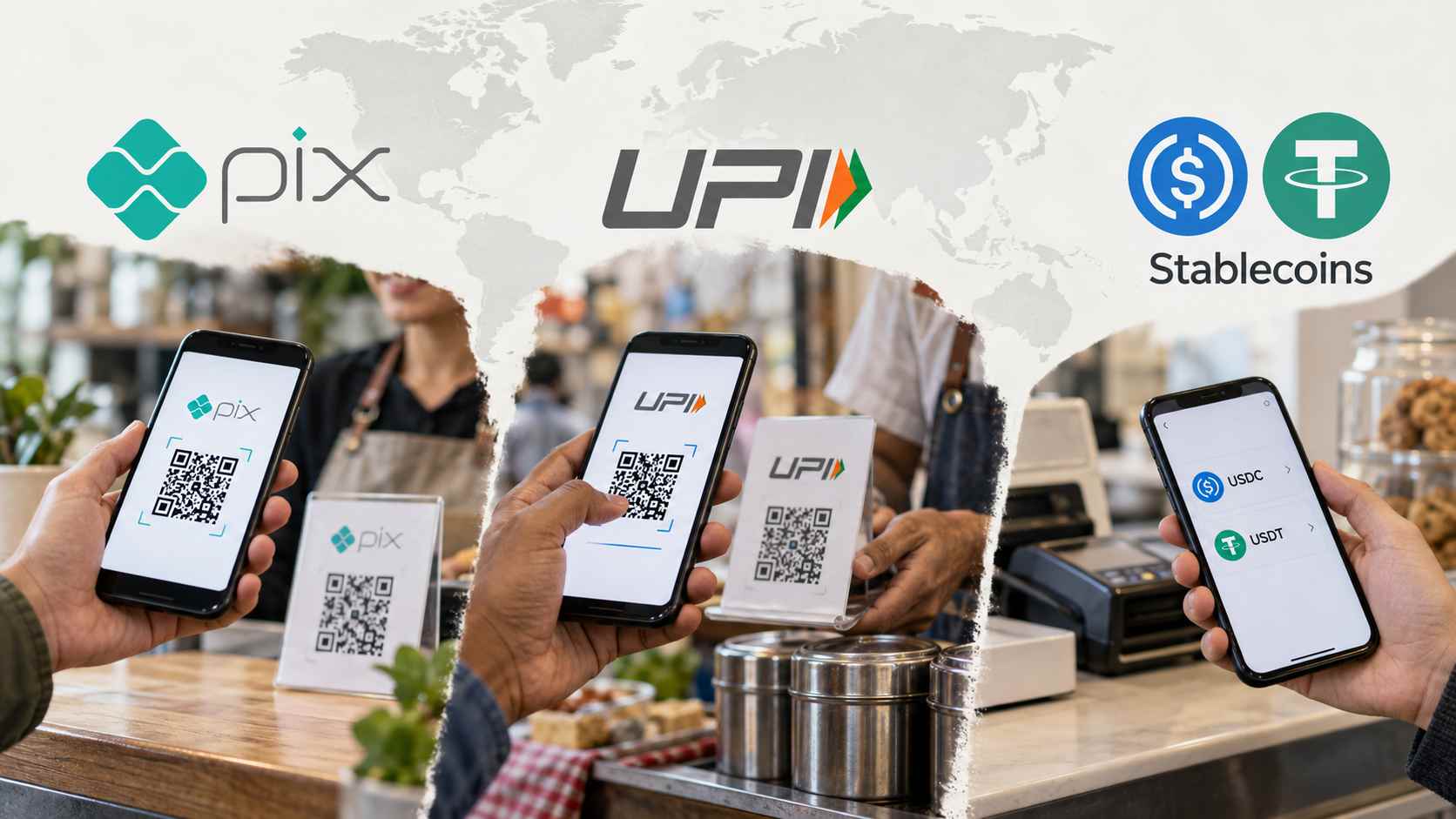
Instant payment systems, digital currencies and stablecoins are expanding alongside traditional card networks, shifting competition toward the cost, reach, interoperability and control of the infrastructure that moves money.
Brazil's Pix processed nearly 80 billion transactions in 2025, while India's UPI handled 23.2 billion in May 2026 alone, according to Boston Consulting Group's Global Payments Report 2026. By June 2026, individuals and businesses in 137 countries had access to 24/7 instant payment services, according to BCG, showing how quickly these systems are spreading alongside traditional card networks.
In Africa, instant payment systems have also expanded across the region, although the market remains fragmented by country and infrastructure. 36 instant payment systems were operating across 31 African countries by mid-2025 and processed 64 billion transactions worth nearly $2 trillion in 2024. BCG says payment infrastructure is also becoming part of a wider debate about sovereignty as tariffs, sanctions and export controls raise the strategic importance of who operates and controls the rails through which money moves.
Domestic payment rails are moving across borders
Several national payment systems are testing whether they can operate beyond their home markets. Brazil has expanded Pix across its border with Argentina, while Poland's Blik has entered Romania and Slovakia. Project Nexus, developed by the Bank for International Settlements and partner central banks, aims to connect instant payment systems across Asia, serving 1.7 billion people.
Linking systems could reduce the need for separate connections between markets, but different currencies, rules and financial infrastructure make implementation harder. BRICS Pay is designed to connect member countries' payment rails without relying on SWIFT or dollar settlement, with a business-to-business launch targeted for the second half of 2026.
The mBridge project, meanwhile, has demonstrated how central bank digital currencies can be used for cross-border settlement. The project was developed by the Bank for International Settlements Innovation Hub with the central banks of China, Hong Kong, Thailand and the United Arab Emirates. Its design points to another possible model for cross-border payments: connecting central bank money directly across jurisdictions rather than relying entirely on correspondent banking.
Payment revenue is growing more slowly
The global payments industry continues to expand, but revenue growth is slowing. BCG expects revenue to rise from almost $2.0 trillion in 2025 to nearly $2.6 trillion by 2030, or 5% a year versus nearly 8% during much of the previous decade.
In Asia-Pacific, payment volumes are expected to grow faster than revenue as lower-monetizing rails gain share. India shows the pattern, with UPI dominating everyday low-value payments while credit cards continue to expand online.
BCG's analysis puts the average shareholder return for payments companies at 6% from 2022 to 2026, compared with 20% for the S&P 500. The performance varied significantly by business model, with some segments such as acquirers and processors under pressure while digital assets, buy now, pay later providers and card issuers performed better.
Latin America's payments market, worth $200 billion in 2025, is projected to grow 7% a year, while the Middle East and Africa market, valued at $98 billion, is expected to grow 8%.
The distinction between payment volume and payment revenue is increasingly important. More transactions do not necessarily translate into proportionally higher revenue when cheaper rails gain market share.
Digital wallets are gaining ground
Digital wallets accounted for 56% of global e-commerce transaction value and 33% of in-store spending in 2026, according to Global Payments' report. The company expects payment apps to account for 46% of global point-of-sale value by 2030, equivalent to $15.6 trillion.
For merchants, the key questions are not simply which payment method is most popular, but how much it costs, how widely it is accepted, how easily it connects with other systems and how much control the merchant retains over the customer relationship.
That creates a competitive tension between scale and openness. A widely accepted rail can reduce friction for merchants and consumers, but greater dependence on a small number of networks can also concentrate pricing power and infrastructure control.
Europe and China are building different digital-money models
The European Parliament voted 416 to 169, with 22 abstentions, on July 9 to advance negotiations with the EU Council on legislation for a digital euro. The vote did not authorize issuance of the currency.
The European Central Bank says it could be ready for a potential first issuance in 2029 if the necessary legislation is adopted in 2026. The ECB has also planned a pilot beginning in the second half of 2027. The Governing Council would decide whether to issue the digital euro only after the legislation is adopted.
The European Parliament's position includes holding limits and other safeguards, while the broader legislative package remains subject to negotiations with EU member states. Parliament has framed the digital euro partly as a way to reduce reliance on non-EU payment providers.
European banks are also developing private-sector alternatives, including euro-denominated stablecoin initiatives, creating a parallel market alongside the proposed public digital currency.
China has taken a different route. Its central bank digital currency, the digital yuan, is already operating, while Chinese authorities have maintained restrictions on private cryptocurrency activity and have taken a cautious approach to stablecoins.
The contrast shows that digital money is developing through different combinations of public infrastructure, private payment networks, regulation and restrictions.
Stablecoins are testing banks' cross-border role
Outstanding stablecoins reached $260 billion by mid-2026, according to BCG, with use growing in cross-border business payments, treasury transfers and remittances. Global Payments estimates that direct crypto payments account for 0.19% of global transaction value and says stablecoins are becoming a more credible cross-border tool as regulation improves.
J.P. Morgan, Citi, HSBC and DBS have tested or launched tokenized deposits for corporate clients, although BCG says these products will not create scalable value until they can move between banks. If digital assets take a larger share of cross-border flows, banks could face pressure on some deposits, float income and transaction fees associated with traditional payment activity. But stablecoins do not eliminate the role of banks. They still require regulated access points, liquidity, foreign exchange conversion and compliance infrastructure in many transactions.
More payment rails are creating a more fragmented market
Instant payment systems and potential central bank digital currencies generally cost merchants less than cards, according to BCG. The European Union has extended caps on certain interregional interchange fees, while Apple has been required to open its tap-to-pay technology to competing wallets.
The trade-off is complexity. Banks, payment providers and merchants face more domestic schemes, wallets and alternative rails, each with different technical and geographic coverage. Cross-border commerce requires those systems to work together across currencies, regulatory regimes and compliance frameworks.
The payments landscape is expanding, but the key question is whether new rails can connect without adding complexity for businesses.