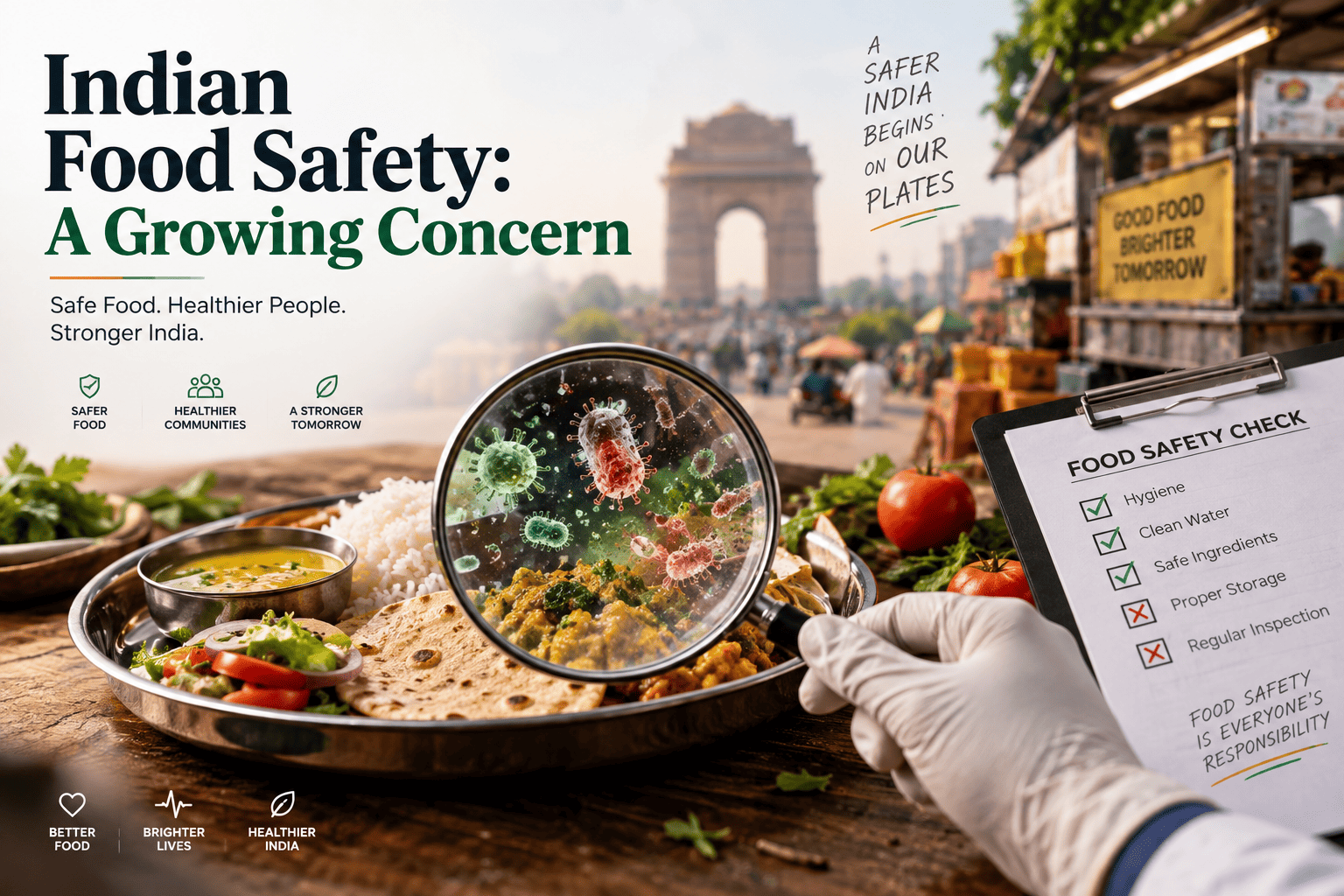
India’s food safety system is facing a test of capacity as regulators intensify inspections, raids, and license cancellations across restaurants, food businesses, and packaged-food operations. The push has brought longstanding concerns over hygiene and adulteration back into focus, while also exposing a harder question: can enforcement keep pace with the scale and changing nature of India’s food market?
An investigation published Sept. 8 found that inspectors have tested more than 100,000 food samples annually since 2020, with roughly one in five found unsafe, substandard or lacking proper labels. Over the last three years, about 8,000 licenses for food businesses have been revoked. The figures demonstrate the scale of violations detected. They also demonstrate the volume of enforcement work facing regulators.
A System Built on Shared Enforcement
India’s food-safety framework operates under the Food Safety and Standards Act, 2006. While state food-safety departments are primarily responsible for inspection, sampling, and enforcement, the Food Safety and Standards Authority of India (FSSAI) establishes standards and collaborates with state and Union Territory authorities.
Risk-based enforcement is necessary in a country of India's scale, but its effectiveness depends on the quality of risk assessment and the consistency of implementation. According to the FSSAI's own inspection guidelines, “it is not feasible to check every food industry due to a shortage of staff”. As a result, its risk-based inspection system allocates resources to companies and goods that are thought to be more likely to present health hazards.
The approach can improve efficiency, but it also makes enforcement dependent on how effectively risk is assessed and acted upon across different states and local jurisdictions.
An Expanded and Intricate Food Market
As the food sector has grown, so too has the regulatory challenge. A more complex and fragmented food supply chain now includes restaurants, street food vendors, packaged food producers, organized retail, internet delivery, and quick-commerce platforms.
Food safety risks can emerge at multiple stages between production and consumption, including storage, transport, preparation, retail handling, and labeling. Before a product reaches customers, food safety can be impacted by storage, transportation, restaurant kitchens, retail handling, and product information.
The spectrum is demonstrated by recent enforcement actions. The current crackdown illustrates how broad the regulatory challenge has become, ranging from hygiene and adulteration to labeling, expiry-date manipulation, and storage practices. Concerns about near-expiry or expired goods being relabeled for export were also brought up by a different Mumbai warehouse probe.
Testing is only the first step
In addition to inspections, effective enforcement also requires the capacity to test samples and respond to infractions. The current situation in Kolkata, for example, illustrates the potential bottleneck: thousands of samples collected during a food-safety drive were being processed through only three laboratories. Enforcement capacity isn't limited to inspectors. It also depends on laboratories, turnaround time, legal follow-up, and the ability to act on results.
Hence, in order to increase access to testing and monitoring, FSSAI has launched mobile testing initiatives in addition to maintaining and growing a network of recognized food-testing laboratories. Its current regulatory records also demonstrate ongoing changes in testing infrastructure and laboratories that have been notified.
Technology could play a more targeted role in closing some of the gaps in India’s food-safety enforcement. FSSAI already uses digital systems for licensing, compliance and inspections, but international regulatory models point to ways these tools could be taken further.
The U.S. Food and Drug Administration, for example, has explored artificial intelligence and machine learning to screen import data for shipments that may pose public-health risks; in one pilot involving imported seafood, the agency found that such tools could substantially improve the likelihood of identifying high-risk consignments. The FDA has also promoted tech-enabled traceability to enable faster identification of contaminated products across the supply chain.
Singapore has similarly adopted a data-driven, risk-based approach, using information from food-safety incidents, non-compliance records and testing results to determine where regulatory attention is most needed.
For India, the opportunity would be to build on FSSAI’s existing digital systems with predictive risk scoring, AI-assisted inspection prioritisation, remote audits for suitable low-risk or compliant businesses, and stronger end-to-end traceability. Such systems would not replace inspectors or laboratories, but could help direct limited manpower toward businesses, products and supply chains presenting the greatest potential risk.
The Question of the Warning-Label
Consumer information is another area where food regulation is expanding. For items that contain at least two of the three nutrients-added sugar, salt, and saturated fat- the FSSAI suggested a red hexagon front-of-pack warning.
The proposed warning-label framework has drawn different objections from different stakeholders. Food industry groups argue that the proposed nutrient thresholds could be too stringent, potentially affecting product sales and competitiveness. Health advocates, however, have raised the opposite concern, arguing that the two-of-three requirement could be too weak because products high in only one nutrient may avoid a warning. The Supreme Court is now examining the issue, while FSSAI has indicated openness to stricter implementation.
The debate also reflects how food regulation is expanding beyond traditional concerns such as contamination and hygiene. Increasingly, regulators are also addressing nutrition, labeling and the public-health risks associated with the information consumers receive about packaged foods. This makes labeling enforcement another part of the broader challenge of ensuring that food regulations translate into meaningful public-health protection.
Reuters reported today that FSSAI told the Supreme Court it is open to implementing stricter labeling measures, including potentially moving from the two-of-three threshold to warnings when any one of the three nutrients exceeds the threshold.
What Comes Next
The most recent crackdown in India demonstrates how enforcement is growing more robust and public. The bigger question, though, is whether that impetus can result in regular oversight as opposed to sporadic action when issues arise.
According to the WHO, national food control systems are crucial for safeguarding public health and guaranteeing safe food throughout supply chains. India would need to make consistent investments in laboratories, inspectors, monitoring, and coordination between national and state authorities in order to strengthen those systems.
A crackdown can generate deterrence. A functioning food-safety system requires routine inspection, reliable testing, consistent enforcement, and prevention. Whether enforcement can change in tandem with the food sector to become more preventive, risk-based, and uniform across the nation will determine its long-term significance.