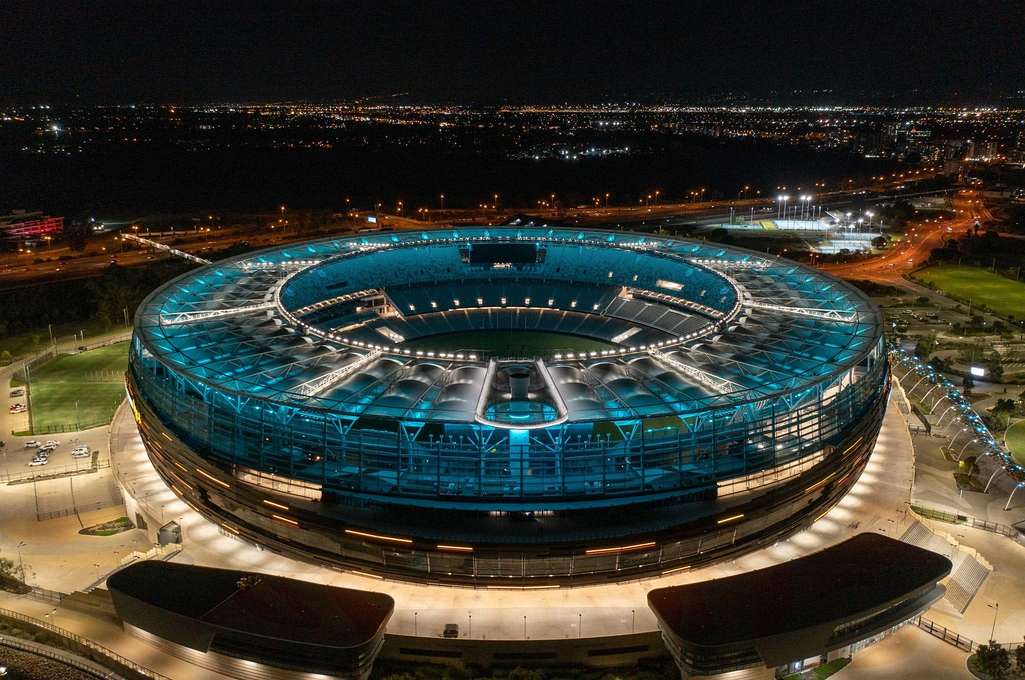
Team owners, leagues and developers are pouring billions into venues and hospitality programs designed to generate revenue long after the final whistle, testing how much fans, corporate clients and host cities are willing to pay for the experience around the game.
Mixed-use districts anchored by stadiums and arenas could draw more than $100 billion in investment over the next 15 years, according to a report published last year by Klutch Sports Group and the Royal Bank of Canada. The estimate reflects a growing strategy among team owners, leagues and private developers to treat the venue as anchors for broader commercial districts.
That shift starts with ticket prices. Average NFL ticket prices sold through Gametime rose 173% from 2015 to 2025 after adjusting for inflation, according to data the ticketing platform shared with Axios. Other leagues saw smaller but still sharp increases over the same period: college football tickets rose 119%, MLB 111%, NBA 70%, NHL 65% and MLS 22%.
Some new stadium projects are opting for smaller seating capacities while expanding premium and hospitality spaces. The Kansas City Chiefs announced in July 2026 that the new enclosed stadium planned for 2031 will hold approximately 70,000 fans, about 8% less capacity than Arrowhead Stadium, while adding more suites, clubs and VIP entrances. The Chiefs' emphasizes that the new venue is designed around fan experience and includes expanded commercial spaces such as a larger team store and Hall of Honor.
Fewer seats, more revenue per seat
The math behind smaller, pricier venues is straightforward: a single luxury suite can out-earn dozens of general-admission seats. By 2018, premium seating accounted for about 20% of a new stadium's inventory but produced more than 40% of ticket revenue and often exceeded 50% in large NFL venues - according to the Association of Luxury Suite Directors, up from just 3% of inventory in 1990. NFL teams averaged $55 million a season in premium-seating revenue last year, about 70% of what they collected from general-admission sales combined, Forbes estimates. NBA teams averaged $45 million, MLB teams $41 million and NHL teams $35 million.
The value is not limited to the ticket itself. Suites and clubs can include private dining, dedicated entrances, premium food and beverages, better sightlines and corporate hospitality. For teams, the customer is often buying access, convenience and business networking as much as a seat.
Hospitality becomes the product
That logic extends past the seating bowl. On Location, which also handles hospitality for the Super Bowl and the Olympics, is the official hospitality operator for the 2026 FIFA World Cup, bundling tickets with travel, dining and access into single packages aimed at corporate and high-spending clients. A Super Bowl LX package this year combined Pebble Beach tee times with four nights at the Inn at Spanish Bay, starting at $14,750 per person. Chief experience officer Brian Wilder told Town & Country the company aims to accommodate nearly any client request: "We really try not to say no."
PredictHQ forecast about $63.3 million in event-driven spending across the Bay Area on Super Bowl LX game day alone, with $51.8 million of that going to hotels - not counting the multi-day travel and lodging built around the event. Hospitality operators increasingly frame these packages as a business-development tool rather than a fan perk, a way for corporate clients to host partners and build relationships around marquee events, according to FIFA's official World Cup 2026 hospitality program.
Stadiums as real estate plays
Nowhere is the shift toward year-round revenue generation clearer than in Miami. Nu Stadium, the 26,700-seat venue where Inter Miami CF began play in April, anchors Miami Freedom Park, a more than $1 billion mixed-use development that is expected to add nearly 1 million square feet of retail, office and entertainment space.
The distinction matters. The stadium itself generates revenue through tickets, premium seating, sponsorships, concessions and events. The surrounding district creates a broader real-estate proposition through retail, offices, hotels, entertainment and other uses.
The broader test is whether a venue can generate repeat visitation and spending independent of any single player or sporting season.
Inter Miami's revenue nearly quadrupled, from $55 million in 2022 to $215 million in 2025, a jump Sportico attributed largely to Lionel Messi's arrival in 2023. Victor Matheson, a sports economist at College of the Holy Cross, said the model succeeds when a venue draws repeat visits rather than relying on game days alone, though he questioned whether Miami keeps its soccer momentum once Messi retires.
Similar bets are underway elsewhere. In Frisco, Texas, Hunt Sports Development is building a mixed-use district around Toyota Stadium that includes a 290-room hotel and a convention center, backed by more than $1 billion in private capital. A separate $215 million renovation of the stadium itself began in March 2025. Financing patterns are shifting to match: the public share of stadium construction costs fell from roughly 70% in the 1990-2000 period to about 50% in the 2010s and closer to 40% since 2020, according to a review cited by law firm McGuireWoods. The firm ties part of that shift to SoFi Stadium, the $5.5 billion, privately financed venue that opened in 2020.
An unresolved public ledger
Private capital hasn't eliminated public risk. Economist J.C. Bradbury of Kennesaw State University, who has studied the Atlanta Braves' Battery Atlanta development in Cobb County, Georgia, found that the county's $300 million public subsidy has not been offset by the tax revenue the project generates, leaving an annual shortfall of roughly $15 million, a conclusion the Braves and Cobb County dispute. His verdict on the deal: it "hasn't been a boon for taxpayers." Bradbury's broader research puts government commitments to major-league venues nationally near $50 billion, a figure that the projects could double by the end of the 2030s as more cities pursue similar projects.
Competing with the couch
The push toward premium experiences also responds to competition from home viewing. Nearly 90 million Americans are expected to watch sports digitally by 2025, an increase of almost 10% from 2021, according to eMarketer data cited in a Mortenson report on stadium design. Ticketing's share of team revenue already varies widely by league, from 17% to 44%, Sportico has reported, leaving venues to compete for discretionary spending against an increasingly capable at-home alternative. Rising prices carry a trade-off: pushing venues upmarket risks narrowing the in-person fan base to those who can afford premium tickets, even as teams deliberately court higher-spending fans.
Whether this approach to venue economics extends much further than Miami, Frisco and a handful of marquee leagues, or whether it further concentrates sports' economics around corporate spenders and premium buyers, remains unresolved. The answer will likely determine which cities' stadium bets pay off by the 2030s and which become cautionary tales.