
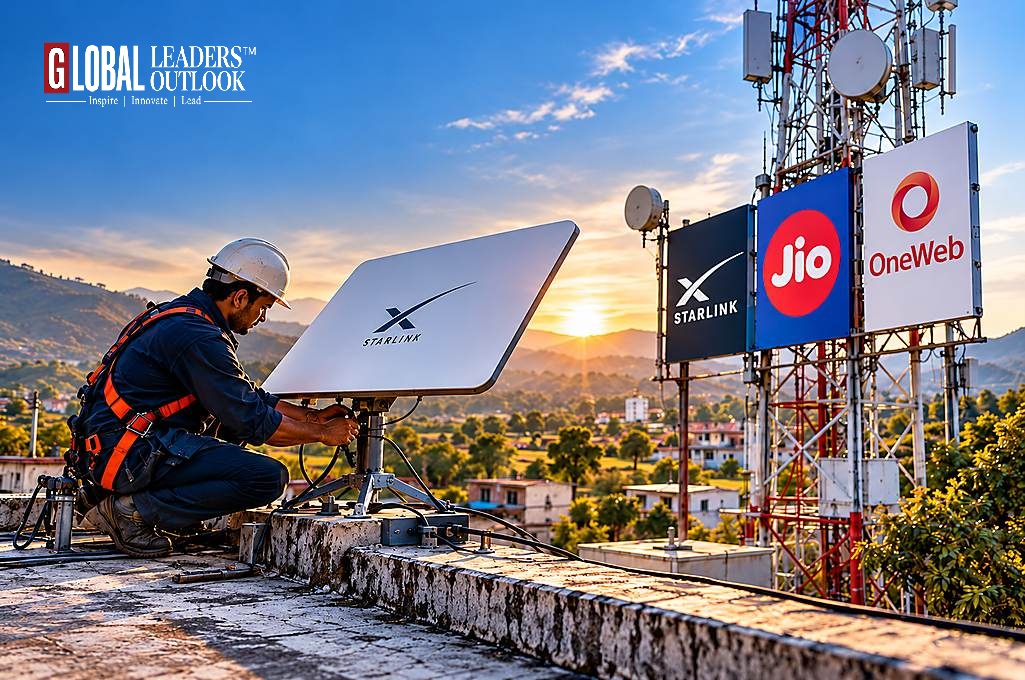
Starlink, Jio and OneWeb are preparing for a new connectivity market, but unresolved security requirements and spectrum rules continue to shape their entry.
In December 2025, Starlink’s India website quietly showed something people had waited years to see: a price. A home plan at ₹8,600 a month, plus a ₹34,000 for hardware. Within hours, it was gone. The company called it a technical glitch and said the figures were not official Indian prices.
Ten months on, that glitch is still the closest India has come to seeing what satellite internet costs. It is why the service remains unavailable despite progress on licensing and infrastructure.
On Oct. 9, Communications Minister Jyotiraditya Scindia confirmed that Starlink, Reliance Jio’s satellite venture and Eutelsat OneWeb all hold licenses. However, none could begin commercial operations until it met the government’s security requirements and the outstanding regulatory conditions were resolved. No launch dates were announced.
Scindia had promised in October 2025 that India would deliver the world’s fastest satellite rollout. A year later, nobody has switched on. This delay reflects a wider challenge for India’s satellite communications market. Providers must demonstrate that their networks can meet national security requirements, establish viable commercial models and operate under spectrum rules that account for the interests of both satellite and terrestrial telecom companies.
Security clearance remains a key barrier
Satellite internet presents a distinct regulatory challenge because its infrastructure extends beyond national borders. Starlink’s low-Earth-orbit satellites use laser links to transfer data between spacecraft, potentially allowing traffic to travel between satellites without passing through a ground station in India. Indian authorities have raised questions about how the network will comply with requirements for domestic oversight, lawful interception and service restrictions during emergencies or conflicts.
These concerns are central to the approval process. The government needs assurances that it can monitor communications as required by law and restrict service in designated areas when necessary. For satellite operators, demonstrating compliance involves more than building gateways and deploying satellites; it requires technical and operational arrangements that satisfy Indian authorities.
Starlink has said it has prepared for these requirements. Vice President Lauren Dreyer has said the company has built 20 gateway sites in India, equipped with hundreds of antennas, and developed India-specific controls to keep user data in the country. Its foreign direct investment approval has also been reported as pending.
India has separately been developing a national satellite communications monitoring facility, announced in October 2025 with a budget exceeding ₹900 crore. The facility is part of the broader effort to strengthen oversight of satellite communications.
The immediate question is whether Starlink’s infrastructure and controls meet the government’s requirements. Until security clearances are granted, technical readiness and investment cannot translate into a commercial launch.
Spectrum rules add another layer of uncertainty
Spectrum charges are another part of the approval process. India chose administrative allocation of satellite spectrum rather than an auction, a route consistent with Starlink’s preference. Jio has argued that satellite operators should not receive terms that give them an advantage over terrestrial telecom providers.
In September 2026, the Digital Communications Commission approved a proposed spectrum charge of 5% of adjusted gross revenue, with a one-percentage-point reduction for eligible rural and remote areas. Cabinet approval remains pending. The Telecom Regulatory Authority of India had recommended a 4% charge in May 2025.
The spectrum charge would be additional to the licence fee, reported at 8% of adjusted gross revenue. Both affect operators’ costs, although the eventual impact on customers will depend on final terms, network expenses and pricing strategies.
The policy challenge is to account for the different economics of satellite and terrestrial networks. Satellite services can connect locations where fibre or mobile infrastructure is difficult to deploy, but regulators must also consider whether the rules create an uneven competitive environment.
Partners and Rivals Complicate the Contest
The delay has also intensified scrutiny of competition. Elon Musk has suggested that powerful business interests are trying to block Starlink to protect their market positions. He did not name specific individuals. The government has rejected claims of preferential treatment and said licensed operators must meet the prescribed requirements.
The commercial relationships are not straightforward. Jio signed an agreement with SpaceX in March 2025 to offer Starlink services to its customers. Bharti Airtel also reached an agreement with SpaceX. Meanwhile, Jio is developing its own satellite communications business, and the Bharti Group backs OneWeb.
These overlapping interests make the market more complex than a contest between a foreign entrant and domestic incumbents. Companies can cooperate in one part of the business while competing in another.
However, overlapping interests do not establish that competitors are responsible for the regulatory delays. The more consequential question is whether the approval process is transparent and predictable for all providers. Calls to block Starlink’s rollout and parliamentary scrutiny of satellite internet have widened the debate beyond launch dates to national security and market access.
Who Will Pay for Satellite Internet?
Even after approvals, satellite internet must find customers willing to pay for it. OneWeb has focused on business-to-business connectivity, including services for telecom operators, enterprises, aviation and maritime users. Its Asia-Pacific Vice President, Neha Idnani, has said satellite connectivity is most relevant where terrestrial networks are technically or commercially unviable. Starlink has been expected to target consumers as well as businesses.
Remote regions offer a potential market. The government’s Digital Bharat Nidhi programme supports connectivity in underserved areas, where satellite services could complement terrestrial infrastructure. Gujarat’s February 2026 letter of intent for satellite connectivity in remote, tribal and border areas illustrates the potential role of government-led projects.
The government expects India’s satellite communications market, including broadcasting, to grow from $4.3 billion in 2024 to $14.8 billion by 2033. That forecast signals a wider opportunity, but it does not establish how much revenue broadband providers will capture.
Affordability remains a significant hurdle. Scindia has said mobile data rates have fallen 96.6%, while 5G coverage reaches 99.9% of the population. Starlink’s previously reported monthly retail price range of ₹2,500 to ₹3,500 remains unconfirmed, and customers would also need to pay for hardware.
For households with reliable mobile broadband, those costs could be difficult to justify. Enterprises, government agencies and users in areas beyond terrestrial networks may be more willing to pay, making them plausible early customers.
Beyond the Launch Date
Security clearances and Cabinet approval of the spectrum charge remain important milestones, but they will not alone determine the market’s success. Pricing, service quality and the availability of alternatives will shape adoption once commercial operations begin.
India must establish rules that protect national security, give providers predictable conditions and support connectivity where conventional networks struggle to reach. The satellite internet race will ultimately depend not only on what companies can deliver from space, but on whether they can meet India’s regulatory requirements and build a viable market on the ground.