Military training is increasingly connecting live exercises with virtual, constructive and synthetic environments, creating a broader market for software, data, interoperability and digital infrastructure.
A $13.9 billion market is already operating around military simulation and virtual training, but its next phase is less about replacing live exercises than connecting them to digital environments. Grand View Research estimates the global military simulation and virtual training market was valued at $13.9 billion in 2025 and will reach $20.42 billion by 2033, a 4.7% compound annual growth rate from 2026 through 2033. North America accounted for 34.4% of the market in 2025.
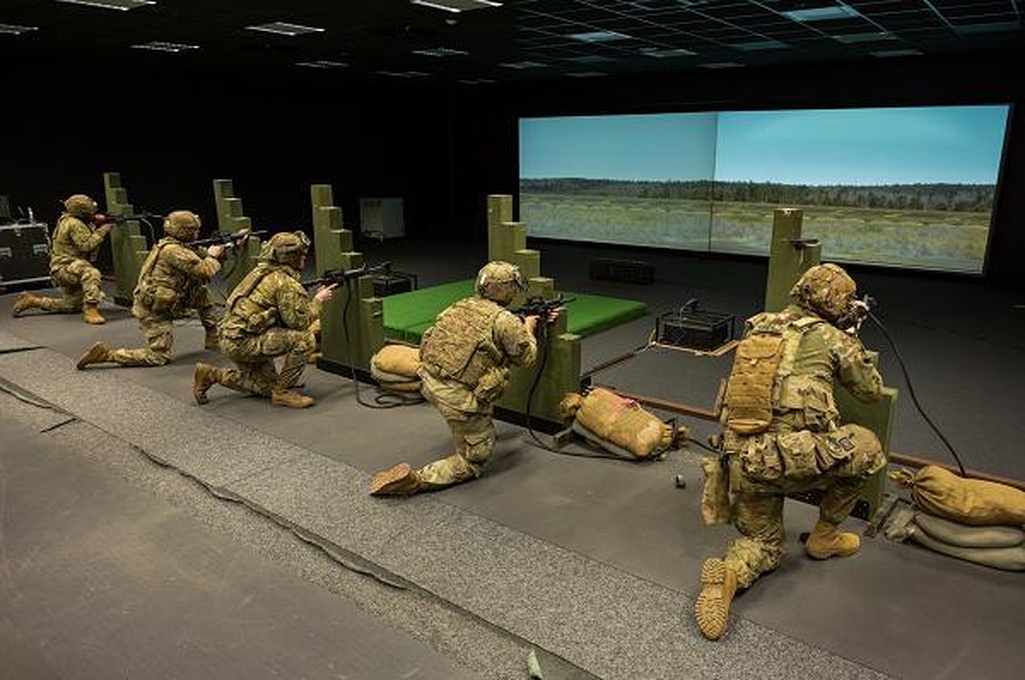
The commercial story is not that militaries are abandoning firing ranges, aircraft, vehicles or ships. It is that those physical assets can increasingly be connected to virtual, constructive and gaming environments, allowing forces to rehearse combinations of events that may be difficult, expensive or unsafe to stage entirely in the physical world. The U.S. Army describes its training model as a blend of live, virtual, constructive and gaming capabilities.
That makes the opportunity larger than the traditional simulator market. Demand is expanding into software, synthetic terrain, networking, sensors, artificial intelligence, immersive systems and the infrastructure needed to connect them.
The new training stack is software-driven
The U.S. Army’s “Training Simulation Software/Training Management Tool”, or TSS/TMT, illustrates how that infrastructure is being built. The Army describes the system as a single, interconnected training and management environment that creates a Common Synthetic Environment in which units can train in live, virtual, constructive or gaming environments, including all four simultaneously.
The platform is also designed to help commanders, staff, trainers and soldiers plan, prepare, execute, monitor and assess collective training. Its listed interdependencies include One World Terrain, the Integrated Visual Augmentation System, the Reconfigurable Virtual Collective Trainer, the Live Training System, the Soldier Virtual Trainer and Next Generation Constructive.
The Army’s Synthetic Environment Core operates at an even more foundational level. The program is building a common virtual environment that links simulation devices into an integrated and interoperable training system. It uses common terrain, models and computer-generated forces so participants can see the same terrain, buildings and vehicles across the Army’s integrated training environment.
Interoperability therefore becomes a commercial issue as well as a technical one. Defense customers need systems that can connect existing training programs rather than create another isolated platform. For suppliers, that expands the opportunity into software integration, terrain generation, simulation tools and long-term system support.
Companies are selling more than simulators
BAE Systems’ Bohemia Interactive Simulations is one example of that expansion. In July 2025, the U.S. Army began an upgraded deployment of “Virtual Battlespace 4”, or VBS4, under its Games for Training program. BAE Systems said the program was already being used across more than 80 simulation centers, schoolhouses and home-station training sites.
The VBS4 upgrade includes an enhanced graphics engine, improved networking and performance, a streamlined user interface and access to a whole-earth terrain server, according to BAE Systems. The platform supports training ranging from individual and squad activities to mission command and staff exercises.
BISim is also working with U.S. Army Futures Command on a “Synthetic Training Environment Mission Planning Toolkit”. The company is developing an end-to-end system for generating 3D data and high-fidelity, game-ready terrain, including imagery captured by an autonomous drone. The prototype reached initial operating capability after BISim integrated its Mantle terrain management platform.
Cubic is targeting another part of the infrastructure. In March 2025, the company received a “10-year multiple-award IDIQ contract” supporting U.S. Army Tactical Engagement Simulation Systems programs. The contract covers engineering and manufacturing for fielded and new training systems supporting home-station training, combat training centers, and foreign military sales.
Together, those programs show how the market extends across software, terrain, instrumentation, and systems integration. The supplier opportunity is becoming broader than the sale of a single simulator.
Synthetic training expands what militaries can rehearse
The strongest commercial case for synthetic environments may be the scenarios they make possible.
The Royal Navy signed a £25 million, five-year contract with QinetiQ in August 2025 for the Maritime Command and Staff Trainer, or MCAST. The system can emulate task-force deployments and opposing forces, creating a synthetic environment for complex operational training.
MCAST reached initial operating capability in August 2026, 11 months ahead of schedule, and was validated during Exercise Virtual Warrior 26. More than 240 Royal Navy staff participated, according to the service. The Royal Navy said the system can reproduce scenarios that would be impossible or unsafe to stage in a live exercise, including casualties, logistical failures and breakdowns in command and control.
The system also changes the pace of training. Scenarios that could take days to play out at sea can be reset overnight, the Royal Navy said, allowing commanders to repeat situations with fewer physical resources. The service is targeting a roughly even split between live and synthetic training by the end of the decade.
That is a different value proposition from simply making exercises cheaper. Synthetic environments can increase the number of iterations commanders can run and make it easier to test difficult combinations of events without repeatedly mobilizing major physical assets.
Data and AI are becoming part of the product
As training systems become more digital, the exercise itself is no longer the only output. The data generated during training can become part of the value.
Lockheed Martin’s “SIMRES” combines live action with a virtual environment using digital-twin technology and real-time sensor fusion. The system records training engagements, captures soldier and weapon movements and supports after-action review through 3D visualizations.
That turns the training environment into a measurement system as well as a rehearsal system. Instructors can examine what happened, while operators can use recorded activity to review performance and engagement outcomes. Lockheed Martin’s “ACES” platform serves a different purpose, focusing on modeling, experimentation and analysis across operational domains.
Artificial intelligence is becoming another layer of this infrastructure. The U.S. Army’s Capability Program Executive for Simulation, Training, Test and Threat says its training ecosystem combines artificial intelligence, modern game engines and simulation technology across live, virtual and constructive environments. Its modernization work also includes a scalable, cloud-based simulation marketplace through Next Generation Constructive.
CAE’s fiscal 2026 filing similarly identifies artificial intelligence, data analytics, machine learning, extended reality and modular simulation architectures among its areas of investment. The company also says synthetic training and mission-rehearsal solutions can complement or provide an alternative to live training.
The commercial implication is that suppliers can compete on data, analytics, interoperability and AI-enabled capabilities as well as on simulation hardware.
Business is becoming hybrid
The direction is therefore not “live versus virtual”. It is live plus virtual plus constructive plus gaming, connected through common infrastructure.
The U.K. Ministry of Defence’s “Serapis framework” reflects that model. Its fifth lot covers simulation and synthetic environments, including tools for defense training, exercises, operational preparation and capability assessment. A separate lot covers data analytics, autonomy, artificial intelligence, machine learning and information visualization.
For defense operators, the business question is increasingly how those layers fit together without creating disconnected systems. For technology providers, the opportunity is to supply and support more of the infrastructure across the life of a training program.
That is what makes the shift significant for the wider defense market. The opportunity is expanding beyond virtual reality into a hybrid training infrastructure built from software, synthetic terrain, networking, sensors, data, AI, digital twins and long-term support. Live exercises remain central to military readiness; the technology business is increasingly about connecting those physical exercises to the digital environments around them.