Autonomous tractors, weeding robots, drones and AI-powered machines are changing how a new generation approaches farm labor and equipment.
Last spring, Kentucky farmer Quint Pottinger planted an entire corn crop without sitting in a tractor. A driverless tractor pulled an eight-row planter across his fields while he monitored it from a distance. His previous 16-row planter covered 60 to 70 acres a day. The driverless eight-row model covers close to 100.
As told to Kentucky Department of Agriculture on May 21, 2026, Pottinger said, “I’m not in it.”
Pottinger is one of several young farmers and agriculture entrepreneurs building businesses around autonomous equipment designed to reduce the need for operators.
From Chemical Drums to Circuit Boards
Agricultural equipment has long been sold on horsepower: bigger tractors, wider planters, more acres covered per hour. A newer group of companies is developing machines designed to operate with fewer people.
Clint Brauer, a third-generation farmer, co-founded Greenfield Robotics after his father developed Parkinson's disease following years working in agriculture. Brauer has linked that experience to his interest in reducing the use of agricultural chemicals. The company builds autonomous robots designed to remove weeds without herbicides.
Charlie Andersen grew up working with machinery on his family's fruit and vegetable farm. He founded Burro, which builds autonomous robots that haul produce and tow loads alongside farm workers in labor-intensive agricultural operations. Hundreds of Burro units are deployed across nurseries, vineyards and berry farms, according to the company.
The labor shortage behind robots
Labor availability and cost are among the clearest reasons farms are experimenting with automation. Roughly one in five U.S. farm positions goes unfilled each year, according to industry estimates. Weed control alone costs the U.S. economy an estimated $46 billion annually in lost yield and labor.
Greenfield Robotics targets the cost of weed control, while Burro focuses on labor costs.
Farmers betting on unproven technology
Some leaders in this shift aren't building robots. They're the first customers.
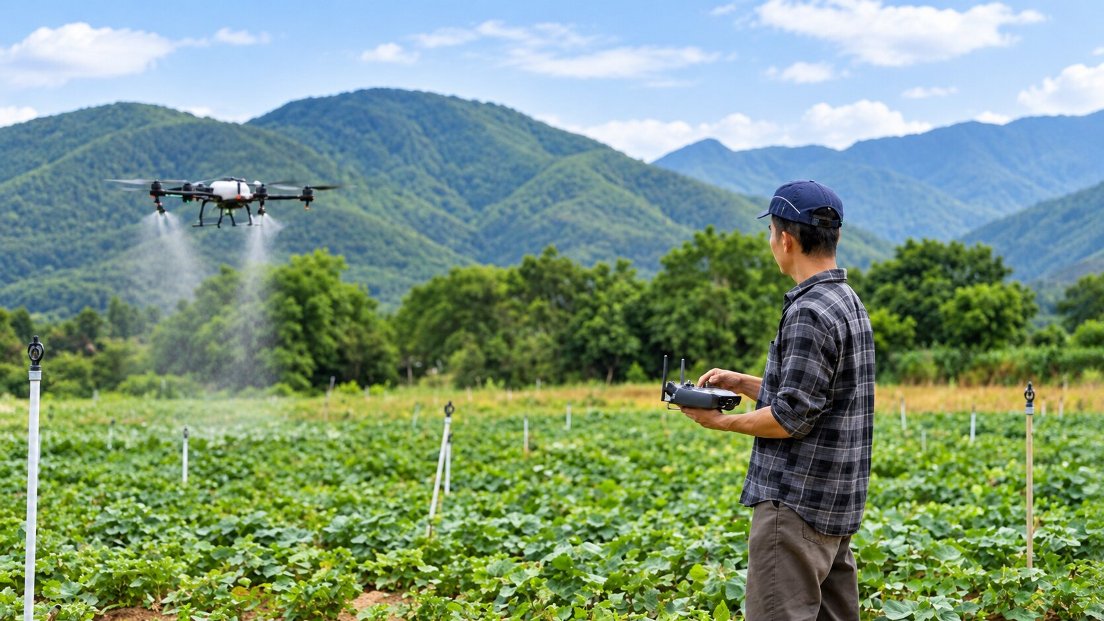
In southern Illinois, 23-year-old Peyton Fallen invested $100,000 to launch a drone-spraying business. His operation reflects a broader shift in which younger agricultural entrepreneurs are using automation as a business opportunity rather than simply adopting it as farm equipment.
In New Zealand, engineer Alistair Scarfe turned university research on autonomous kiwifruit harvesting into Robotics Plus. Yamaha Motor invested in the company in 2017 and acquired it in 2025. The acquisition gave Yamaha control of a business focused on agricultural automation and autonomous harvesting technology.
In India, 18-year-old Aryan Singh built an AI-powered rover called AgRobot after watching farmers in his family struggle to afford commercial machinery. Singh won the Pradhan Mantri Rashtriya Bal Puraskar, a national child award, for the project.
Capital Follows the Shift
Agricultural robotics ranks among the most heavily funded categories in agtech, according to industry trackers. Investment spans autonomous tractor systems, precision sprayers, agricultural drones and robots designed for harvesting and material movement.
One venture-backed company develops autonomous driving systems that retrofit existing tractors, allowing growers to automate tasks without buying new equipment. That retrofit model is significant because it can lower the capital barrier for farmers who already own conventional machinery. Precision-spraying startups market systems that claim to cut herbicide use by up to 95%.
Investment in agricultural AI and automation is expected to remain strong through 2027, according to industry analysts. Food-security concerns, climate pressure on production, and rising demand for sustainably grown food are among the factors driving investment.
The Next Planting Season
For all the investment and experimentation, autonomous farming remains a small part of the overall agricultural equipment market. Fewer than 50 U.S. farms currently plant crops autonomously, according to the Kentucky Department of Agriculture. Pottinger's operation is one of them.
Sabanto, an Ames, Iowa-based company, provides the guidance system controlling Pottinger's tractor. The company also runs autonomous tillage and seeding operations on other farms, including large-scale mowing on sod farms. The approach illustrates one of the industry's more practical paths to automation: adding autonomous capabilities to existing equipment rather than requiring farmers to replace entire fleets.
Sabanto CEO Craig Rupp has said he sees the shape of the wider industry in operations like Pottinger's: smaller autonomous machines that can perform specific tasks while reducing the need for a person to remain in the cab.
Technology, however, still faces questions around upfront costs, reliability, safety, connectivity, maintenance, and whether autonomous systems can deliver a sufficiently strong economic return across different crops and farm sizes.