Ipsos' 43-market survey finds consumers increasingly focused on the present, domestic products and familiar brands, while attitudes toward AI remain divided.
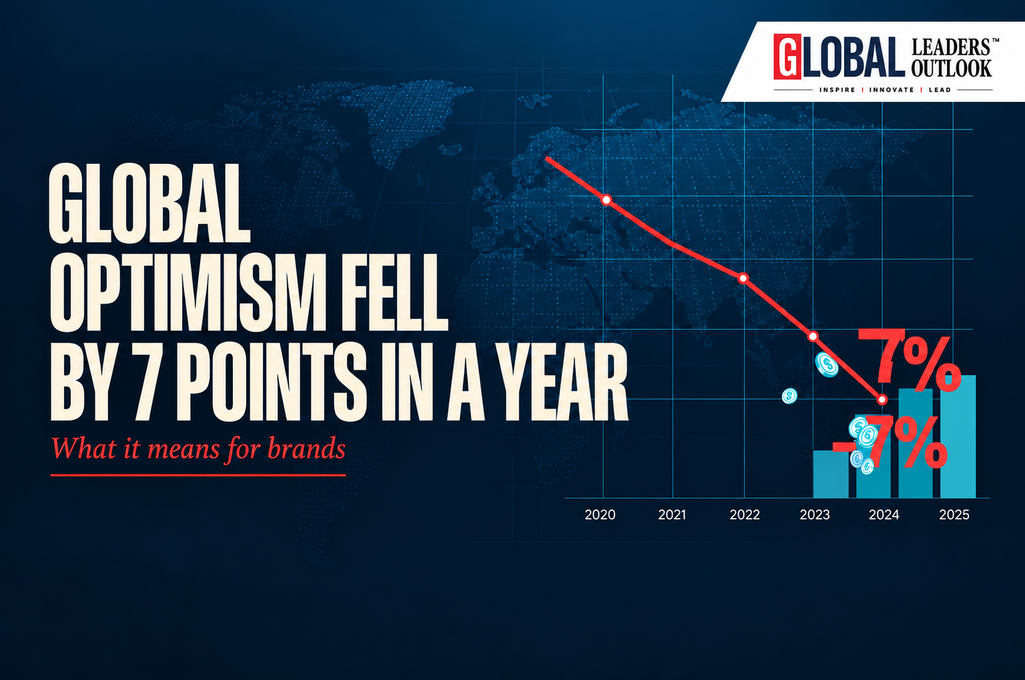
Global optimism has weakened over the past year, with 59% of respondents saying they feel optimistic about themselves and their families and 45% feeling optimistic about their city or town. Both figures are down 7 percentage points from a year earlier, according to Ipsos' 9th Edition of its Global Trends report.
The report, titled "The Uneasy Decade," places the change within a broader period of uncertainty marked by rising geopolitical tensions, trade disputes and the rapid spread of artificial intelligence. The findings may suggest a consumer mindset that is becoming more cautious about what lies ahead, while trust is increasingly reserved for institutions, people and brands that already feel familiar. The business question is whether these attitudes translate into different purchasing behavior.
Consumers are putting more weight on the present
For many respondents, uncertainty about the future appears to be affecting how they think about the present. About 66% said they live for today because the future is uncertain, and a majority of respondents shared that view in all but three markets: Israel, the Netherlands and Sweden.
The global figure was only slightly higher than in 2024, and Ipsos said the increase was not statistically significant. Some markets did record larger rises, including the UAE, Ireland, Portugal and Indonesia.
The findings on government are similarly cautious. About 70% of respondents said their government does not prioritize people like them, while 77% expected governments and public services to do too little to help in the years ahead. Ipsos also points to financial pressures that may be making major milestones such as buying a home, getting married and starting a family harder for many people to reach.
That shift in priorities could affect businesses. Ipsos sees potential opportunities in categories such as socializing, vacations, clothing and beauty, while businesses tied to larger, longer-term commitments, including cars, pension plans and mortgages, may face a tougher environment. Ipsos suggests the shift could favor categories associated with immediate consumption, including socializing, vacations, clothing and beauty, while products tied to larger long-term commitments could face greater pressure. Those are implications identified by Ipsos rather than purchasing trends demonstrated by the survey itself.
Domestic products gain appeal
Consumers appear to be showing a stronger preference for products made closer to home, although that does not necessarily mean they have rejected globalization. In its first year asking about the issue, Ipsos found that 70% of respondents preferred products from their own country over those from abroad.
At the same time, attitudes toward globalization remained largely positive. About 64% said globalization is good for their country, while 60% said it is good for them personally. Ipsos said the latter figure has remained steady.
Support for trade barriers is less consistent and varies considerably between markets. In Mexico, 62% of respondents favored more barriers, compared with 41% in Canada and 37% in the United States.
Ipsos said tariffs have disrupted logistics and destabilized some product categories, while global brands have responded by emphasizing their local presence and domestic brands have used the shift to expand. The report points to Coca-Cola's focus on its local operations and Mexico's 2025 relaunch of the "Hecho en México" label, which it says is aimed at reducing reliance on imports.
Familiarity continues to shape brand trust
Trust appears to be moving closer to consumers' immediate circles, including family, friends and local officials. That same preference for familiarity is visible in how people approach brands.
Some 77% of respondents said they are more likely to trust a new product from a brand they already know, while 67% said they tend to buy brands that reflect their personal values. Among the markets surveyed in both 2013 and 2025, the share of people willing to pay extra for a brand with an appealing image rose to 52%, from 39% in 2013.
Ipsos describes this trust as fragile because a brand's public values can create tensions when expectations differ between consumers. Still, 81% of respondents said a brand can support a good cause while also making money, suggesting that consumers do not necessarily see purpose and profitability as conflicting ideas.
The customer experience presents another problem. Around 75% said service has become too automated and impersonal, and Ipsos identifies the expanding role of AI in customer relationships as an area of uncertainty for brands.
AI is creating a divided response
Technology brings its own contradiction. While 71% of respondents agreed that only modern technology can solve future problems, 56% said technological progress is destroying their lives. The same tension appears in attitudes toward data. About 74% said they are concerned about how companies use their data, yet 47% also said people worry too much about privacy.
Ipsos said the share of respondents who believe AI is having a positive impact has increased, although public opinion appears to be changing more slowly than the technology itself. China and Hong Kong were particularly positive about AI, while 39% of respondents in the United States said it has a positive impact on the world.
The United States is described in the report as one of the more skeptical markets, despite being a leading developer of the technology. For brands deploying AI in the United States, that skepticism could make transparency and trust particularly important, although the survey does not measure how those attitudes affect adoption or purchasing decisions.
Consumers want more control, but not more choice
Traditional ideas of career success do not appear to be the only measure of a good working life. Some 86% of respondents said work-life balance matters more than having a successful career, while 84% agreed that each person must work out their own principles.
Ipsos also argues that personalization is moving from a premium feature toward a basic expectation. AI makes it easier for companies to provide more tailored experiences at scale, but it also means brands have to account for the algorithms shaping what consumers see.
More choice is not always welcome. About 62% of respondents said they often feel overwhelmed by having too many options, suggesting that personalization can create a new problem even as it attempts to solve an old one.
Climate concern remains high
Concern about environmental damage remains widespread, even though the sense of urgency around personal action may be more complicated. About 78% of respondents agreed that the world is heading toward environmental disaster unless people change their habits quickly, up from 73% in 2014.
At the same time, 71% said they are already doing all they can. Ipsos says affordability concerns are competing with sustainable options, which may help explain why concern about the environment does not always translate into a willingness or ability to do more.
What the survey can and cannot show
Ipsos surveyed 33,083 adults through its Global Advisor online platform between May 23 and June 6, 2025. In 22 markets, including China, Brazil, Mexico and the UAE, the samples were more urban, educated or affluent than the wider populations. Ipsos says the findings in those markets reflect the more "connected" segment.
The global average is a simple average of markets rather than a figure adjusted for population size. Ipsos gives a credibility interval of 3.5 percentage points for samples of 1,000 and 5 percentage points for samples of 500.
There is another limitation worth keeping in mind: the survey captures what people say they think and feel, not what they actually purchase. A stated preference for domestic products or familiar brands does not necessarily translate into the same behavior at the checkout.
The outlook for optimism remains uncertain
The 9th edition records a 7-point decline in optimism, but it does not show whether that change is temporary or likely to last.