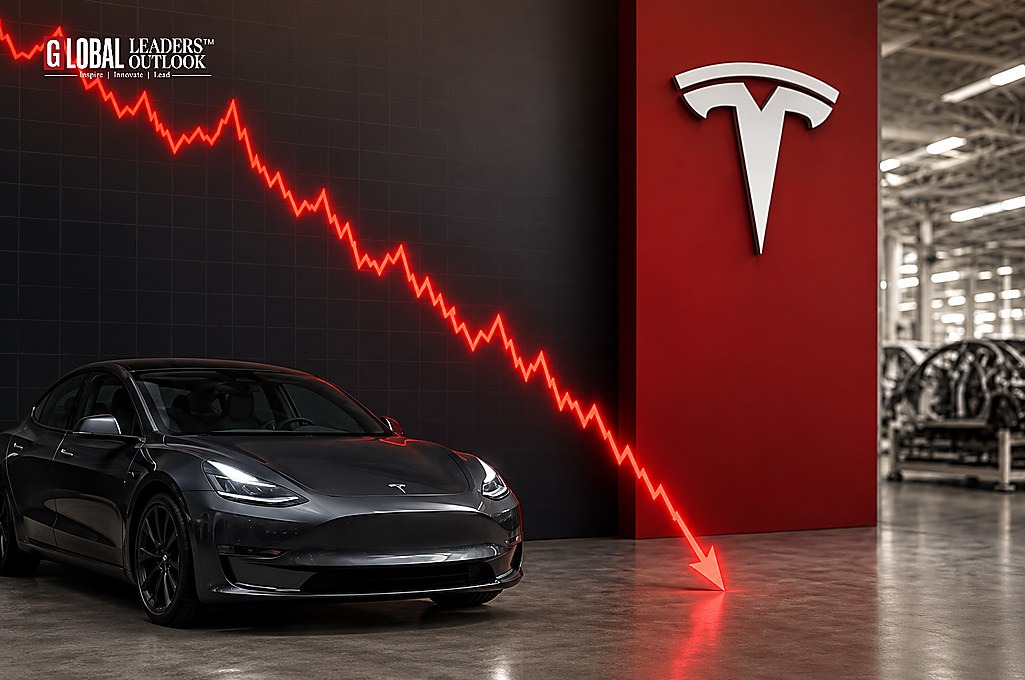
Tesla’s third-quarter revenue held flat at $28.046 billion as rising research spending and stock-based compensation pushed operating expenses higher. Operating margin narrowed to 2.6%, while vehicle deliveries declined 2%.
Tesla Inc. (NASDAQ: TSLA) said Wednesday that third-quarter operating income fell 55.8% to $718 million from $1.624 billion a year earlier. Revenue was largely unchanged at $28.046 billion, while vehicle deliveries declined 2%.
Operating margin narrowed to 2.6%, down from 5.8% a year earlier, although it improved from 1.4% in the second quarter, when operating income was $398 million. The results were reported in the company’s filing with the U.S. Securities and Exchange Commission (SEC).
Research spending, stock pay lift costs
Operating expenses rose to $4.776 billion from $3.430 billion. Tesla attributed the increase mainly to Super Intelligence and other research projects, stock-based compensation tied to the 2025 CEO Performance Award, and selling, general and administrative costs.
Research and development spending increased to $2.761 billion from $1.630 billion. Stock-based compensation rose to $1.165 billion from $663 million.
Gross profit, however, increased to $5.494 billion from $5.054 billion, lifting gross margin to 19.6% from 18%.
Regulatory credit revenue fell to $113 million from $417 million, and energy gross profit also declined. Tesla said both factors weighted on operating income. Growth in services and other gross profit, a better mix of vehicle regions and products, and lower restructuring expenses partly offset the drop.
Deliveries top output as inventory shrinks
Tesla delivered 486,532 vehicles during the quarter, down from 497,099 a year earlier but up from 480,126 in the second quarter. Production increased 4% to 464,391. Days of supply, a measure of inventory, fell to 11 from 15 in the second quarter.
The company said battery availability remained the limiting factor in increasing automotive volumes and that it ended the quarter with its largest passenger-vehicle backlog in four years.
Automotive revenue was $20.56 billion, down from $21.205 billion. Energy generation and storage revenue fell to $2.881 billion from $3.415 billion, partly because of tariff-related customer refunds, it said. Storage deployments rose to 13.7 gigawatt-hours from 12.5 gigawatt-hours.
Services and other revenue increased to $4.605 billion from $3.475 billion, providing a partial offset to lower automotive and energy revenue.
Net income falls despite positive free cash flow
Net income attributable to common stockholders was $787 million, or 22 cents per diluted share, compared with $1.373 billion, or 39 cents. Adjusted earnings were 48 cents per share, down from 50 cents.
Free cash flow was $1.531 billion, against $3.990 billion a year earlier. That marked a recovery from negative free cash flow of $1.092 billion in the second quarter, but remained below the year-earlier level.
Capital expenditures increased to $4.732 billion from $2.248 billion a year earlier. Tesla reported $45.447 billion in cash, cash equivalents and short-term investments as of Sept. 30.
Cybercab rides begin, Optimus production starts
Tesla began providing Robotaxi rides in Cybercabs on Sept. 3 in Austin, Texas. It said cumulative unsupervised Robotaxi miles reached nearly 2 million by the end of the quarter. Active Full Self-Driving subscriptions were 1.74 million, up from 1.04 million a year earlier.
The company said it began volume production of the Tesla Semi in Nevada and started Optimus robot production on high-volume lines in Fremont, California.
Hardware profit outlook stated
Tesla said it expects hardware-related profits over time to be accompanied by an acceleration of Super Intelligence, software and fleet-based profits. Deliveries and deployments will depend on aggregate demand, supply chain readiness and how vehicles are allocated between customer sales and Tesla’s own fleet.
The company said it plans to reach 400 megawatts of Super Intelligence training compute by the end of 2026. It plans to start commissioning equipment at its Austin semiconductor fab in 2027.