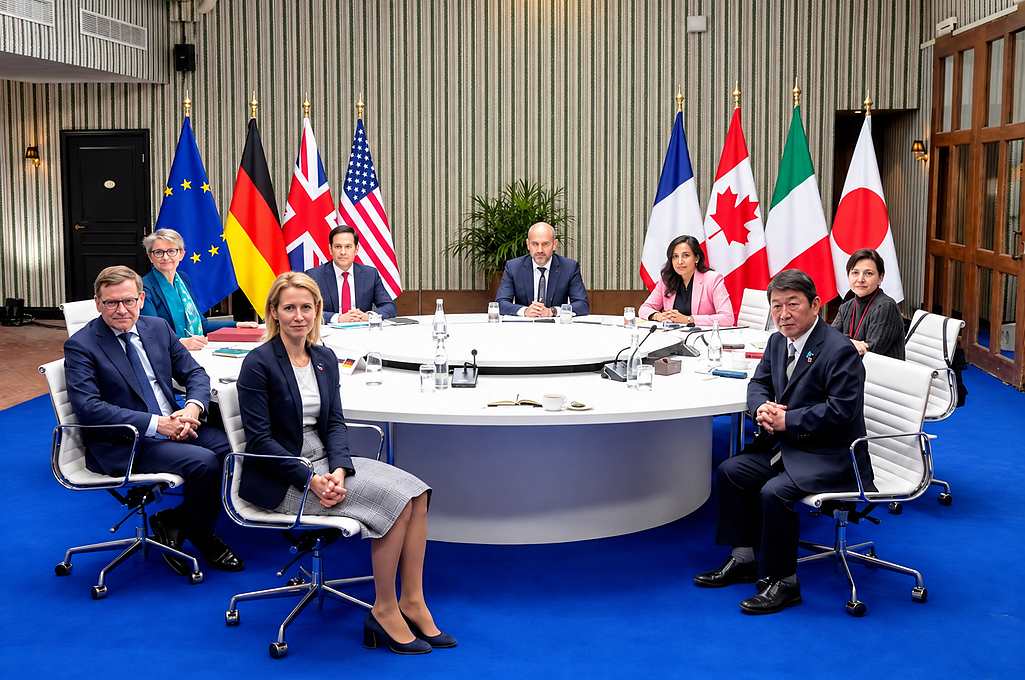
The ministers also urged the Houthis to halt attacks on civilian shipping and return to the political process.
G7 foreign ministers on Monday called on Iran to end its arming and support of Yemen’s Houthis and urged the group to halt military operations and attacks on civilian shipping, as renewed fighting threatens regional stability and key trade routes. The ministers issued the call in a joint statement after meeting in New York on the sidelines of the U.N. General Assembly.
The ministers condemned continued Houthi strikes in Yemen and against Saudi Arabia and called on the group to return to the political process in good faith. The statement comes as the conflict has intensified along Yemen’s western coast, raising fresh concerns over regional security and the safety of shipping through the Red Sea and Bab el-Mandeb.
Saudi Arabia faces renewed Houthi attacks
Saudi Arabia said its air defenses intercepted a ballistic missile launched toward Riyadh on Saturday. The missile was intercepted before reaching the Saudi capital, according to The Associated Press.
The Houthis have also launched drone and missile attacks against Saudi Arabia. The group has threatened and attacked Saudi-linked shipping in and around the Red Sea and Bab el-Mandeb, according to AP.
Houthi forces have also advanced along Yemen’s western coast, seizing the port city of Mocha and several Red Sea islands. The advances have brought the group closer to the Bab el-Mandeb Strait, a major maritime chokepoint linking the Red Sea with the Gulf of Aden. About 12% of global trade normally passes through the waterway, according to widely cited estimates. s
Britain offers defensive support to Saudi Arabia
Britain has separately agreed to provide limited military support to Saudi Arabia. British Prime Minister Andy Burnham said the Royal Air Force will provide air-to-air refueling for Saudi aircraft carrying out defensive missions.
The arrangement is expected to last several weeks and will remain under review. The British government has described the assistance as defensive support and has not committed British forces to offensive strikes against the Houthis.
The decision follows a request from Saudi Arabia as it faces renewed missile and drone attacks from Yemen.
Renewed conflict in Yemen
The latest escalation follows years of fighting between the Houthis and Yemen’s internationally recognized government. The Houthis took control of Sanaa in September 2014 and later expanded across northern and central parts of the country. Saudi Arabia led a multinational coalition into the conflict in 2015 to support the government.
A ceasefire in 2022 reduced fighting across much of Yemen, but the truce was not formally renewed after expiring in October that year. The latest escalation has since brought renewed clashes and military operations along the country’s western coast.
The fighting has increased concerns over the security of the Bab el-Mandeb, where any sustained disruption could affect commercial shipping between the Red Sea and the Gulf of Aden.
Displacement and casualties rise
The renewed fighting has also caused further displacement in Yemen. The International Organization for Migration said 129,438 people had been displaced across seven Yemeni provinces, with displacement rising by 11,352 people over a three-day period.
The World Health Organization reported 164 deaths and 516 injuries between Sept. 13 and Sept. 18, bringing the total since Aug. 6 to 674 deaths and 2,998 injuries.
The latest displacement adds to an already severe humanitarian crisis in Yemen, where repeated waves of conflict have forced communities to leave their homes.
Houthis reject wider involvement
A senior Houthi official has warned other countries against joining Saudi Arabia in the conflict. Mohamed al-Bukhaiti, a member of the group’s political bureau, told AP that the Houthis had assured the Trump administration that they would not target U.S. vessels in the Red Sea, except for Saudi-linked vessels.
Al-Bukhaiti said the Houthis would continue attacking Saudi Arabia until Riyadh ended what the group describes as a blockade of areas under its control. He also said the group remained open to negotiations under those conditions, according to AP.
The Houthis’ position comes as the G7 calls on Iran to end its military support for the group and asks the Houthis to stop attacks on civilian shipping and return to the political process. The latest Houthi statements do not indicate that the group has accepted those demands.
.jpeg)