
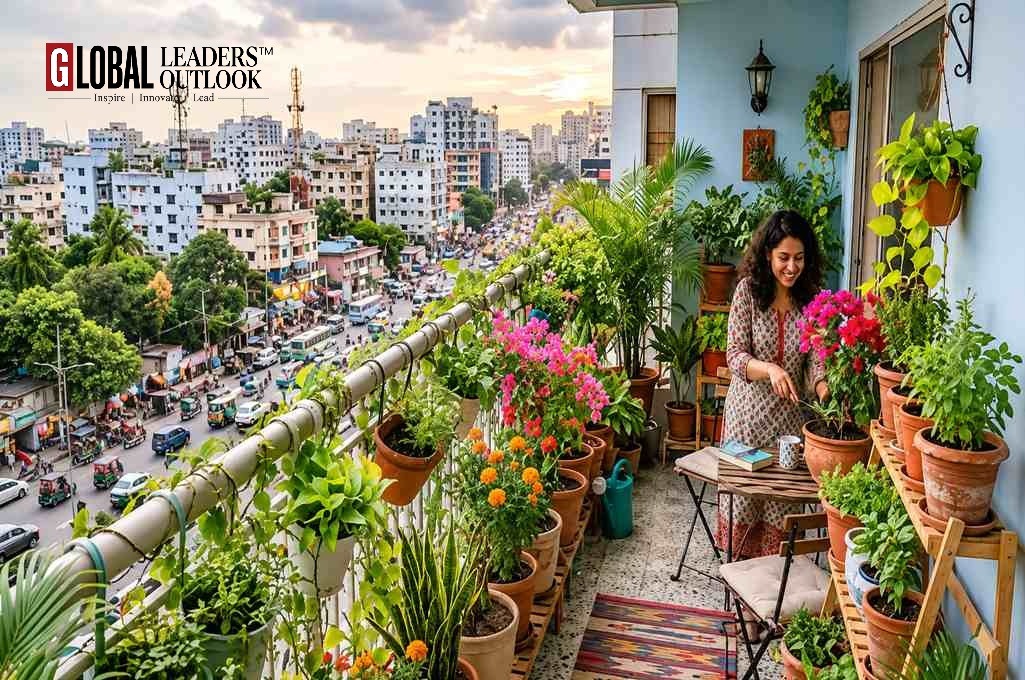
The ability to grow plants at home often depends on access to outdoor space, shared terraces and basic infrastructure.
Poonam Ahuja started in 2020 with a single tulsi plant for her morning prayers. Today her terrace and balcony in Delhi’s Lajpat Nagar, which together cover about 150 square feet, hold more than 150 kinds of plants, including brinjal, pumpkin and citrus trees.
What began during the COVID-19 lockdown has become a lasting part of her daily routine. Ahuja is among the Delhi residents, from students to retirees, who continued growing plants on balconies and windowsills after restrictions eased. . That raises two questions this article tries to answer: why a habit that started in lockdown has lasted, and what decides how far it can spread among people who live in flats.
A habit that outlasted lockdown
Gardening offers a form of engagement that fits into everyday routines. A few minutes spent watering plants or checking for new growth can produce visible results, from fresh leaves to ripe tomatoes. Unlike screen-based entertainment, it requires patience and continued attention. For people who spend much of their day online, that tangible progress may be part of its appeal.
Research offers some insight into the relationship between gardening and well-being, although the findings require careful interpretation. A 2026 survey of 210 residents of Shymkent, Kazakhstan, found that people who gardened reported lower stress than those who did not, even when they gardened only once a week, while higher overall well-being appeared mainly among those who gardened at least twice a week. The most common way non-gardeners in that survey spent their free time was watching television or movies.
A separate study involving 370 residents of the Minneapolis area examined daily activities and emotional well-being. Participants used a phone app to record their activities and moods over one week. Of the participants, 118 reported gardening. The activity ranked among the top five of 15 activities for emotional well-being, but did not outperform walking, biking or eating out. It also ranked below some leisure activities, including going to the movies.
The two studies differ because they ask different questions. The Kazakhstan survey compares gardeners with non-gardeners, so its result may partly reflect who chooses to garden, such as people with calmer routines or more free time. The Minneapolis study compares how the same people feel during different activities, and it suggests that gardening feels about as good as a walk. Neither study shows that gardening causes a better mood, so the safest reading is that gardening is one good everyday pleasure and not a cure for stress.
The limits of a balcony garden
The opportunity to garden, however, depends heavily on the design and space available within a home. Apartment residents often rely on pots, hanging baskets and shelves in place of garden beds, and the daily work consists of watering, checking leaves for pests and picking whatever is ready. A north-facing balcony receives little direct light, a high-rise balcony can hold only so many pots, and water can be hard to spare in summer.
The Kazakhstan survey points the same way, since lack of space was the most common reason non-gardeners gave for not gardening, cited by 18 of the 75 non-gardeners.
For some residents, the problem extends beyond private balconies. Divya Sharma, who lives in Dwarka, told ThePrint that she cannot use her building’s terrace because every household shares it, so her kitchen garden stays on a small balcony. Her situation shows that opening a shared terrace to gardeners is a decision for the housing society and not for the individual resident, and a society that agrees must still settle how much weight the roof can carry and who pays for the water.
Government support for urban gardening remains uneven as Delhi’s 2022 Smart Urban Farming initiative stalled over pending approvals and elections, while Kerala subsidizes vertical gardens, Tamil Nadu has distributed gardening kits, and Bihar has promoted terrace gardening since 2021. These initiatives indicate policy interest, but their reach and continuity will determine how much they contribute to wider participation.
Who gets to garden in the city?
Urban gardening sits at the intersection of personal choice and shared urban space. Its appeal lies in the simple pleasure of watching something grow, but sustaining that habit requires suitable space, sunlight and water. Those conditions are not equally available to residents, particularly in dense cities where many households depend on limited balconies or shared building facilities.
As cities become denser, making room for gardening will require housing societies and local governments to treat it as more than an individual household activity. The real test is whether cities can make this small pleasure accessible beyond those who already have the space for it.