Third-quarter revenue reached €133.8 million as the French defense technology supplier expanded manufacturing and maintained higher 2026 financial guidance.
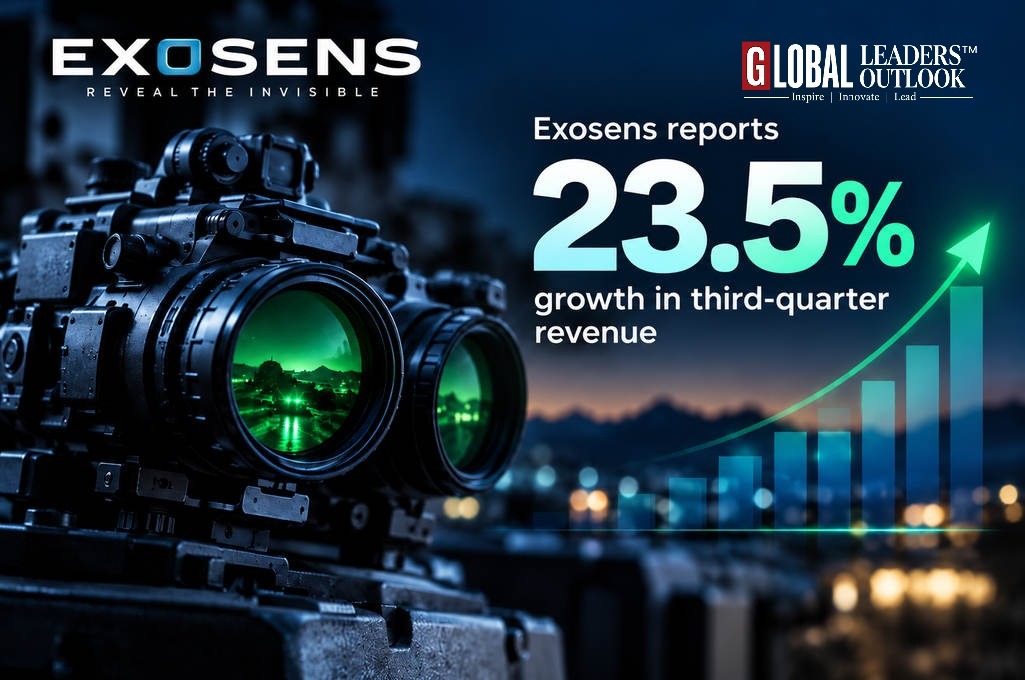
Exosens (Euronext Paris: EXENS), a French manufacturer of night vision, imaging and detection technologies, reported third-quarter revenue of €133.8 million on Tuesday, up 23.5% from €108.3 million a year earlier.
Excluding currency effects and acquisitions, revenue increased 20.5%. Revenue for the first nine months of 2026 totaled €386.9 million, up 18.0% from €327.8 million. Growth was 19.7% in the first quarter and 11.4% in the second.
The group attributed the quarterly growth to higher demand and a faster-than-expected ramp-up of European production capacity. It confirmed 2026 guidance of €558 million to €570 million in revenue and €186 million to €192 million in adjusted EBITDA, or earnings before interest, taxes, depreciation and amortization.
On Sept. 17, Exosens raised the ranges from €520 million to €540 million for revenue and from €168 million to €178 million for adjusted EBITDA.
Night vision tube production expands in Europe
Exosens’ Amplification segment, which includes image intensifier tubes for night vision devices, reported nine-month revenue of €267.8 million, up 15.5%. Its third-quarter revenue rose 23.9% to €91.5 million, after 11.6% growth in the first half.
Demand exceeded available production capacity over the nine months, Exosens said. Higher volumes delivered under procurement programs, including the OCCAR framework for the German and Belgian armed forces, drove the growth, it added.
Production ran throughout August for the first time under an extended operating schedule, and new equipment was commissioned in the first phase of the European expansion.
The group plans a 40% increase in image intensifier tube capacity across Europe and the U.S. by 2027. Construction is also underway on a new U.S. manufacturing facility.
U.S. Army night vision program enters production
Exosens U.S. subsidiary received an order in August for 1,600 night vision systems under the U.S. Army’s Binocular Night Observation Device program. The order is the first delivery under an indefinite-delivery, indefinite-quantity contract announced March 2. The contract has a maximum value of $352.6 million and an estimated completion date of Feb. 27, 2033.
The order marks the transition from testing and qualification to low-rate initial production, Exosens said. Photonis Defense will manufacture and test the systems in the U.S., using Exosens image intensifier tubes.
Exosens expects first deliveries by the end of 2026 and most deliveries during 2027. It did not disclose the value of the August order.
Gross margin rate declines
Adjusted gross margin was €194.9 million over nine months, up 16.1%. As a share of revenue, it fell to 50.4% from 51.2%. The rate was 48.6% in the third quarter, compared with 52.1% a year earlier.
Exosens attributed the nine-month decline to product mix, including deliveries of complete night vision systems by its NVLS subsidiary, acquired in July 2025, and to staffing costs at its U.S. facility. The company also cited a high comparison base, with the Amplification segment’s margin rate at 54.9% in the third quarter of 2025. Its 2026 guidance already reflects these effects, it said.
Imaging segment targets higher camera capacity
Revenue in Exosens’ Detection & Imaging segment reached €120.0 million in the first nine months, up 23.7%, including €42.5 million in the third quarter against €34.7 million a year earlier. Acquisitions contributed to growth, including Noxant in March 2025, Phasics in October 2025, and Emberion, a Finland- and UK-based infrared sensor maker, on April 24. Like-for-like revenue growth was 14.1%.
The company cited demand for imaging products in drone and counter-drone applications and for nuclear instrumentation. It plans to triple thermal camera production capacity and double cooled infrared camera capacity in 2026.
On Oct. 8, Exosens said it supplied neutron flux monitoring detectors to Antares Nuclear and Valar Atomics. Their reactor designs were the first two to reach criticality, a self-sustaining nuclear chain reaction, under the U.S. Department of Energy’s Reactor Pilot Program. Exosens said the milestones are expected to lead to pre-series production orders in the near term.
Demand across other markets was mixed. Global uncertainty weighed on scientific research and microscopy component demand, and inventory drawdowns in mass spectrometry, now complete, softened detector demand. Industrial control markets showed signs of recovery.
Annual results scheduled
Exosens will publish its full-year 2026 results before the market opens on Feb. 22, 2027.
The company said it will issue its 2027 guidance alongside those results.