TestGorilla has released its latest report, The State of Hiring for AI Fluency 2026, revealing that 59% of organizations made what they describe as a “bad AI hire” during the past year. The study highlights how companies are increasingly prioritizing AI fluency over traditional domain expertise when evaluating candidates.
According to the research, 53% of hiring leaders now prefer candidates with strong AI skills and adaptability rather than relying solely on deep subject matter expertise. However, despite the growing focus on AI capabilities, many organizations are struggling to accurately assess real-world AI competence during the hiring process.
The report surveyed nearly 2,000 senior hiring leaders across the United States and the United Kingdom and found that 72% of UK organizations and 71% of US organizations have formally defined what AI fluency means within their businesses. At the same time, almost every company surveyed now considers AI fluency a key hiring requirement.
Despite these efforts, 59% of organizations in both markets admitted they hired candidates who appeared knowledgeable about AI during interviews but later failed to apply those skills effectively on the job.
Wouter Durville, CEO of TestGorilla, explained that companies are increasingly searching for AI-augmented professionals who can significantly improve productivity using emerging technologies. However, he warned that many candidates can quickly learn AI terminology and discuss concepts such as agentic workflows, retrieval-augmented generation (RAG), and prompt chaining without having practical implementation experience.
The report identifies what TestGorilla calls the “Infrastructure Paradox,” where organizations are investing heavily in AI-focused hiring strategies but still relying on outdated and ineffective evaluation methods.
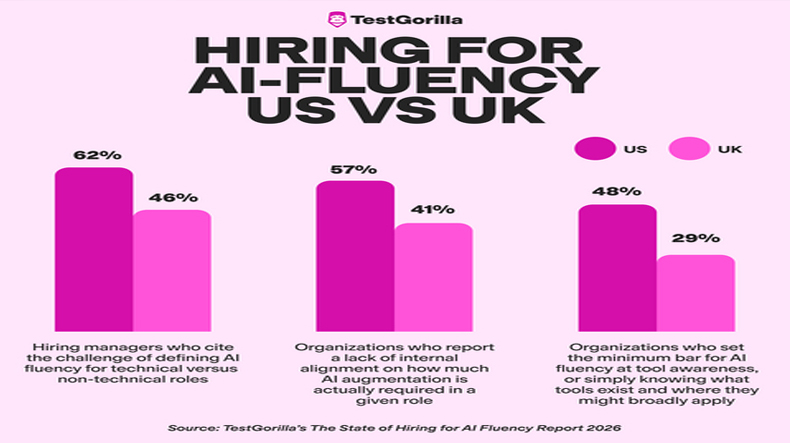
The study outlines three major hiring challenges:
The report warns that a poor AI hire can create significant costs for organizations, including productivity losses, failed projects, and additional recruitment expenses.
The research also highlights a notable divide between US and UK organizations. About 33% of US businesses reported frequent AI-related operational errors, compared to only 13% of organizations in the UK.
UK employers were also found to have more rigorous standards for AI competency. Only 29% of UK companies considered simple tool awareness sufficient, compared to 45% of organizations in the US.
Despite these differences, the report concludes that subjective hiring methods are increasingly unreliable for evaluating AI capability. TestGorilla argues that objective, skills-based assessments are becoming essential for accurately identifying AI-competent candidates.
The findings are based on a February 2026 survey of 1,928 senior hiring leaders across 29 industries in the US and UK. The research was further supported by insights from TestGorilla’s “Hire for the AI Era” virtual event and frameworks developed by organizations including Zapier, IBM, Microsoft, and LinkedIn.
About TestGorilla
TestGorilla is a skills-based hiring platform used by more than 10,000 organizations worldwide to improve recruitment through objective talent assessment. The platform offers more than 350 scientifically validated assessments, AI interviews, resume scoring tools, and job simulations designed to help companies evaluate candidates based on practical abilities rather than traditional resumes alone.
.jpeg)